Updated 2026-10-11 · Originally published 2026-02-19
Useful thyroid testing distinguishes current hormone function from an autoimmune cause and from structural thyroid concerns. TSH and appropriate free T4 testing commonly address function; selected antibodies address different questions. More markers are not automatically more informative. Ask what each test would change, and do not use routine reverse T3 or unrelated commercial panels as proof of a hidden thyroid cause.
Evidence note: The original educational article below is preserved. Added guidance distinguishes established diagnostic methods from hypotheses and test limitations; original claims are not proof that a diet, infection panel or supplement causes or reverses thyroid disease.
Getting a thyroid diagnosis shouldn't end with a prescription. For most patients with hypothyroidism, Hashimoto's, or chronic thyroid symptoms, there are underlying causes driving the problem — and those causes can be found. But only if you test for them.
This is a complete breakdown of what a root-cause thyroid evaluation actually looks like and why each category matters.
Category 1: Full Thyroid Hormone Panel
This is where everything starts — and where standard care usually stops too soon.
A complete panel includes:
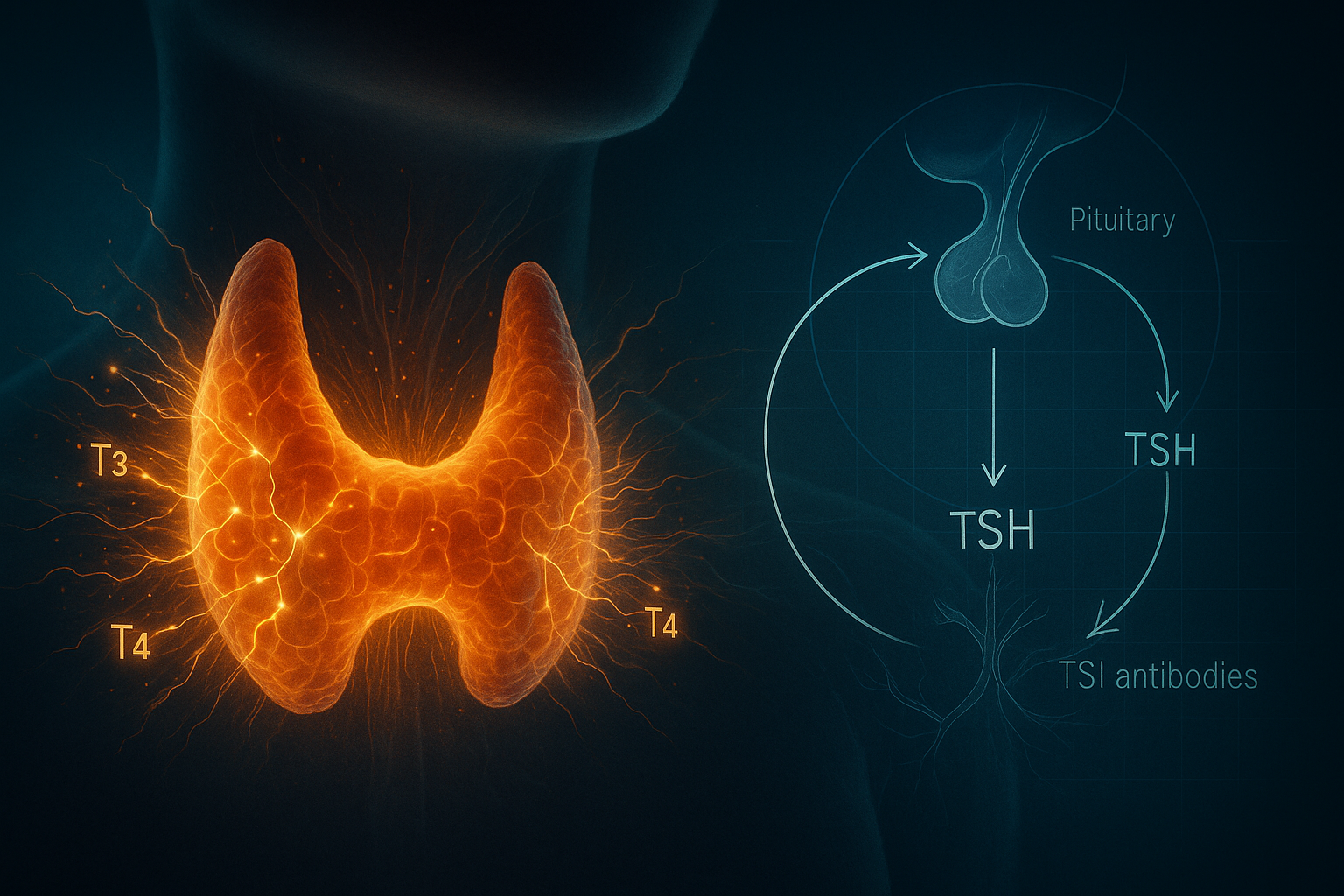
- TSH — pituitary signaling marker; useful but not sufficient alone
- Free T4 — primary thyroid hormone output
- Free T3 — active form used by cells; the most clinically relevant marker
- Reverse T3 — inactive decoy; high levels indicate conversion failure
- TPO Antibodies — primary Hashimoto's marker
- Thyroglobulin Antibodies — secondary Hashimoto's marker
Together these markers tell you whether the thyroid is producing hormone, whether it's converting properly, whether it's being blocked, and whether the immune system is attacking it.
Category 2: Viral & Immune Panel
Viral infections are among the most underappreciated triggers of autoimmune thyroid disease. Viruses can disrupt immune regulation in ways that initiate or worsen autoimmune attacks on the thyroid — and this process can persist long after the acute infection resolves.
We test for:
- Epstein-Barr Virus (EBV) — chronic EBV reactivation is documented in Hashimoto's patients
- HHV-6 — linked to autoimmune thyroid activity
- Hepatitis C — associated with higher rates of thyroid disease
- HSV 1 & 2 — immune burden contributor
- SARS-CoV-2 markers — post-COVID thyroiditis and subacute thyroiditis are increasingly recognized
- Celiac antibodies — both disease and sensitivity affect thyroid health
Category 3: Nutrient Status
Thyroid hormone cannot be synthesized, converted, or used without adequate micronutrient levels. We test:
- Vitamin D — immune regulation; low levels strongly associated with Hashimoto's
- Iron & Ferritin — low ferritin (even within "normal" range) impairs T4-to-T3 conversion
- Magnesium — broadly involved in enzymatic thyroid pathways; deficiency is extremely common
- Zinc — required for thyroid receptor binding
- Iodine — direct building block of thyroid hormone; both deficiency and excess are problematic
Category 4: Adrenal & Hormone Testing
Adrenal dysfunction and thyroid dysfunction are so commonly co-occurring that treating one without evaluating the other routinely produces incomplete results. We use gender-specific testing to capture the full picture:
- Men — Salivary Test Panel: 4-point salivary cortisol to map the full daily rhythm, plus DHEA
- Women — Urine Hormone Test Panel: Complete hormone mapping including cortisol rhythm, estrogen (total and fractions), progesterone, DHEA — and critically, the distinction between estrogen dominance (excess estrogen relative to progesterone) and estrogen decline (perimenopause/menopause), since these affect the thyroid differently
Estrogen dominance, for example, raises TBG (thyroid binding globulin), which reduces the amount of free — usable — thyroid hormone in circulation. This is a common and commonly missed driver of thyroid symptoms in women.
Category 5: Food Sensitivity Testing
Dietary inflammation is a major and modifiable driver of autoimmune thyroid disease. Standard allergy testing (IgE) misses the delayed immune response (IgG) that drives most food sensitivities.
We use the Alletess 184-Food IgG Panel, which tests immune reactivity to 184 foods. The panel is particularly focused on identifying:
- Gluten reactivity (wheat, barley, rye)
- Dairy reactivity (casein, whey)
- Soy
- Coffee
- Eggs and other common triggers
Results are used to build a personalized elimination and reintroduction protocol.
Category 6: Gut & Stool Analysis
The gut is not separate from the thyroid — it's central to thyroid health in multiple ways. The gut lining is where a significant portion of T4-to-T3 hormone conversion occurs. Gut bacteria produce enzymes needed to activate thyroid hormone. And a disrupted gut lining (leaky gut) drives the chronic immune activation that fuels Hashimoto's.
Our stool analysis includes:
- Intestinal permeability markers — to identify and quantify leaky gut
- Comprehensive microbiome mapping — to assess bacterial diversity, beneficial species, and pathogens
- Pathogen screening — bacteria, parasites, fungi, viruses that create immune burden
- Inflammation markers — to gauge overall gut inflammatory load
Putting It All Together
No single test tells the whole story. What makes our evaluation different is that we look at all six categories together and interpret them as a system — because that's how the body works.
A patient might have:
- Normal TSH but high Reverse T3
- Positive EBV reactivation alongside high TPO antibodies
- Low ferritin and vitamin D
- Moderate estrogen dominance compressing free thyroid hormone
- Strong gluten and dairy reactivity driving intestinal inflammation
- An overgrowth in the microbiome feeding the inflammatory cycle
Every one of those findings requires a different intervention. And you can't know what you're dealing with until you test for it.
TSH and free T4
TSH reflects the pituitary signal to the thyroid; free T4 helps assess circulating hormone. A clinician interprets the pair with symptoms, medication, pregnancy status and relevant history. Results after acute illness or a recent medication change may need different interpretation.
T3, antibodies and reverse T3
T3 is often more helpful in evaluating hyperthyroidism than diagnosing hypothyroidism. TPO or thyroglobulin antibodies may support evaluation of autoimmune thyroid disease; TSH-receptor antibodies address different questions. Reverse T3 is not routinely useful for diagnosing hypothyroidism or guiding replacement treatment in otherwise healthy outpatients. Availability does not establish clinical necessity.
Preparation and follow-up
Provide a complete medicine and supplement list, including biotin. Ask the ordering clinician whether fasting, dose timing or a temporary supplement pause is necessary for your specific test. Do not independently stop medication. Discuss what each proposed test would change, costs and who will explain the results.
What does normal actually mean?
A laboratory result includes a value, units, reference interval and collection date. A result inside that interval does not explain every symptom, and it should not automatically be reclassified as disease using an unvalidated optimal range. TSH with appropriate free T4 testing usually provides more useful information than routine reverse T3 testing.
What else can be considered?
Sleep disorders, anemia, medication effects, depression, anxiety, menopause, nutritional problems and other medical conditions can overlap with thyroid symptoms. Your primary medical clinician can help decide which possibilities warrant investigation. The aim is an accurate diagnosis, not a predetermined thyroid explanation.
How can you prepare?
Record when symptoms began, sleep patterns, major changes, medicines and supplements. Bring complete prior lab reports. A free discovery call can explain the practice’s assessment approach and whether a fuller consultation seems appropriate, but it cannot diagnose you or replace urgent care.
How do you avoid confusing association with cause?
Two health findings can occur together without one proving the cause of the other. For example, an antibody result, a history of an infection and persistent fatigue may all be genuine findings, but the combination does not establish that the infection caused autoimmune thyroid disease or that treating an unrelated laboratory marker will improve thyroid function. Ask what evidence supports the explanation, whether there are alternative explanations and which part of the proposed plan has demonstrated benefit. It is reasonable for an assessment to contain uncertainty. A careful explanation distinguishes established thyroid disease from hypotheses about contributing factors and from general steps that support health. That distinction also prevents a supplement, diet or commercial test from being presented as a proven replacement for standard medical care.
What would an organized review look like?
An organized review starts by confirming the clinical question: an established thyroid diagnosis that needs monitoring, symptoms without a clear diagnosis, or a new structural finding such as a neck lump. Next, assemble existing results and identify gaps that matter for that question. Then discuss a limited set of next steps with a clinician qualified to order and interpret them. Agree on who will communicate the results, the expected follow-up interval and what symptoms require earlier contact. Record how symptoms are affecting daily life so follow-up has a meaningful reference point. This is a consultation-preparation framework, not a branded treatment protocol or a claim that one pathway fits every patient. It can help Wilmington, Leland, Hampstead and Jacksonville residents organize a conversation before deciding whether travel or another consultation is worthwhile.
How do you compare a panel with a targeted testing plan?
List the individual questions, not just the number of markers. Thyroid function, autoimmunity, structural thyroid concerns, suspected allergy and digestive symptoms require different evidence. A large panel can include measurements that are available but not clinically useful for your concern. Ask the ordering clinician to identify the purpose of each group and how results will be interpreted together. This does not mean additional testing is never appropriate. It means the recommendation should have a reason that is more specific than finding hidden causes. A smaller plan with clear follow-up can be more informative than an extensive report with no agreed action.
What should be explained about unexpected results?
Before testing, discuss how uncertain or unexpected findings will be handled. A result outside a printed interval does not always establish disease, and a result inside it does not explain every symptom. Ask whether a finding would need confirmation, whether recent illness or supplements could interfere and whether interpretation belongs with another specialist. Avoid purchasing a treatment package solely because a report highlights many values. The responsible clinician should connect each meaningful finding to the history and clinical question. It is reasonable to ask for time to understand that explanation before agreeing to the next stage.
What does informed consent to testing include?
Understand the specimen type, collection instructions, anticipated cost and method of receiving results. Ask whether a test is part of standard medical assessment or an offered test with important limitations. Also clarify who will act on an urgent result and how your usual medical clinician will receive relevant information. The free discovery call can explain consultation logistics, but individualized test selection should occur through the appropriate clinical process. Do not stop medication or make major diet changes to prepare for a test without instructions from the clinician responsible for it.
Select a test by the question it answers
| Test or assessment | Purpose | Important boundary |
|---|---|---|
| TSH and free T4 | Assess thyroid function | Interpret with history and treatment |
| Selected thyroid antibodies | Assess an autoimmune cause | Positive antibodies are not identical to hypothyroidism |
| Reverse T3 | An offered measurement | Not routinely useful to diagnose outpatient hypothyroidism |
| Ultrasound or specialist assessment | Evaluate a structural concern | Blood panels cannot replace nodule evaluation |
Questions and answers
How do you compare a panel with a targeted testing plan?
List the individual questions, not just the number of markers. Thyroid function, autoimmunity, structural thyroid concerns, suspected allergy and digestive symptoms require different evidence. A large panel can include measurements that are available but not clinically useful for your concern. Ask the ordering clinician to identify the purpose of each group and how results will be interpreted together. This does not mean additional testing is never appropriate. It means the recommendation should have a reason that is more specific than finding hidden causes. A smaller plan with clear follow-up can be more informative than an extensive report with no agreed action.
What should be explained about unexpected results?
Before testing, discuss how uncertain or unexpected findings will be handled. A result outside a printed interval does not always establish disease, and a result inside it does not explain every symptom. Ask whether a finding would need confirmation, whether recent illness or supplements could interfere and whether interpretation belongs with another specialist. Avoid purchasing a treatment package solely because a report highlights many values. The responsible clinician should connect each meaningful finding to the history and clinical question. It is reasonable to ask for time to understand that explanation before agreeing to the next stage.
Sources and further reading
- American Thyroid Association: Thyroid hormone treatment
- American Thyroid Association: Hashimoto’s thyroiditis
- NIDDK: Thyroid tests
- American Thyroid Association: Thyroid function tests
- NIDDK: Hashimoto’s disease
- NIDDK: Graves’ disease
- American Thyroid Association: Thyroid nodules
- Endocrine Society: Adrenal fatigue
- AAAAI: Limits of food IgG panel testing
- NIDDK: Diagnosis of celiac disease
- American Thyroid Association: Hypothyroidism during pregnancy
Educational information only, not medical advice, diagnosis or a treatment plan. Do not stop, start or change prescribed medication based on this resource. Pregnancy, children, significant heart symptoms and complex endocrine disease require appropriate medical care. Seek emergency help for chest pain, severe breathing difficulty, fainting, or high fever with confusion and a very fast heartbeat. A discovery call is not urgent medical care.