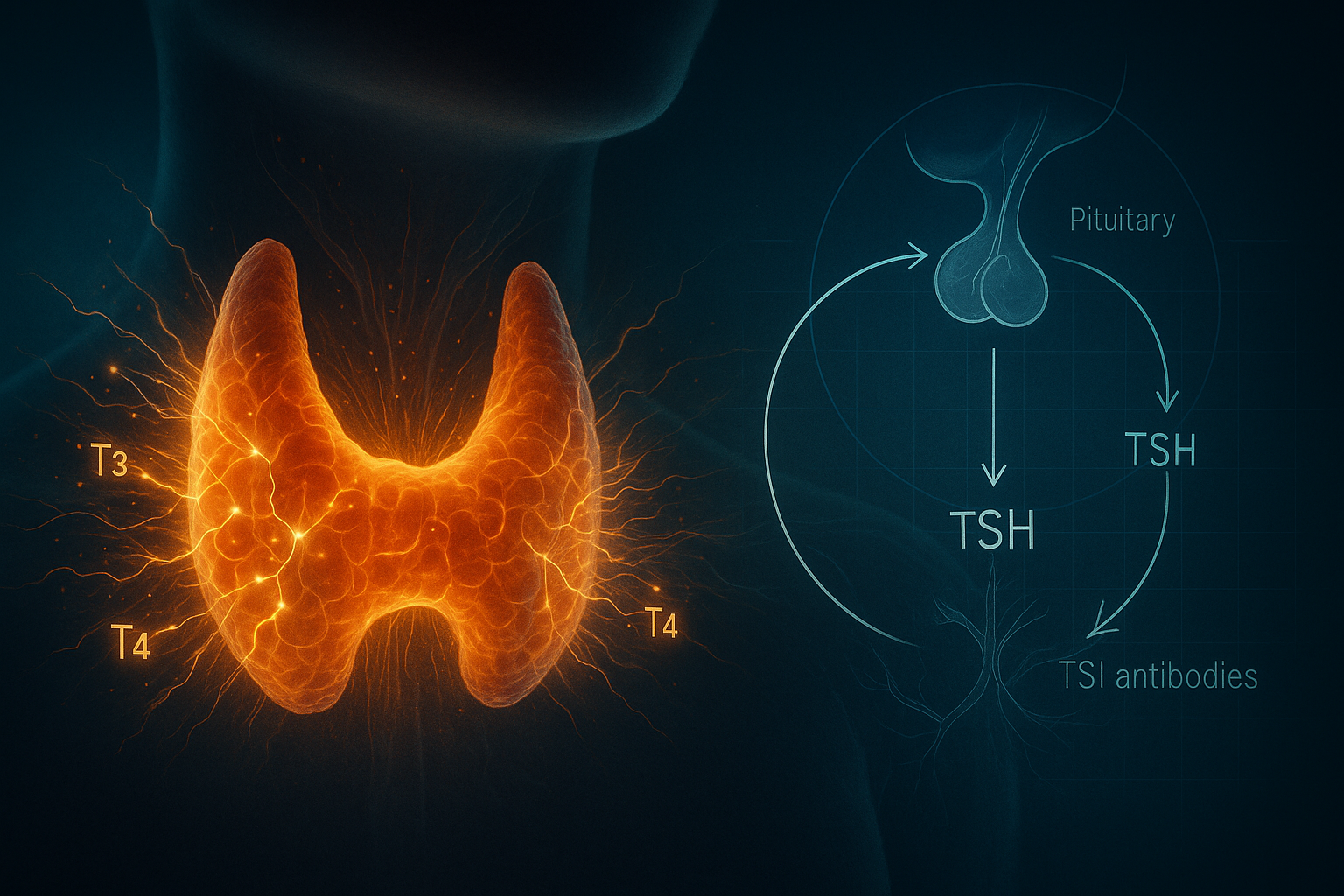
Updated 2026-10-11 · Originally published 2026-03-29
Persistent symptoms deserve attention even when thyroid results are in range, but those symptoms do not prove an undetected thyroid disorder. Review the complete reports, clinical context and the possibility of other causes with your medical clinician. An expanded panel is worthwhile when it answers a specific question; it should not automatically redefine a normal result as disease.
Evidence note: The original educational article below is preserved. Added guidance distinguishes established diagnostic methods from hypotheses and test limitations; original claims are not proof that a diet, infection panel or supplement causes or reverses thyroid disease.
Does any of this sound familiar to you?
- You’re constantly tired
- You struggle with weight gain
- You’re always feeling cold or sensitive to the cold
- You’re constipated and/or have less than 1 bowel movement per day
- Your skin is dry
- Your hair is falling out or is just brittle
- You have muscle weakness/aches
- You’re depressed
- Your memory is not great
- Your voice is hoarse
- Your face and/or your extremities are puffy
- And finally……Your Doctor says your thyroid numbers look fine. Your thyroid is fine.
You’re not fine (and you know it).
Well guess what? - There is an answer for this and it’s likely in the form of something called Reverse T3
Ever heard of it? Most people haven’t. Read on….
Reverse T3 (rT3) is an inactive thyroid hormone that acts as a "brake" on metabolism, often elevated in Hashimoto's when stress, infection, inflammation, or T4-only medication (such as levothyroxine or synthroid) prevents proper conversion of T4 into active T3.
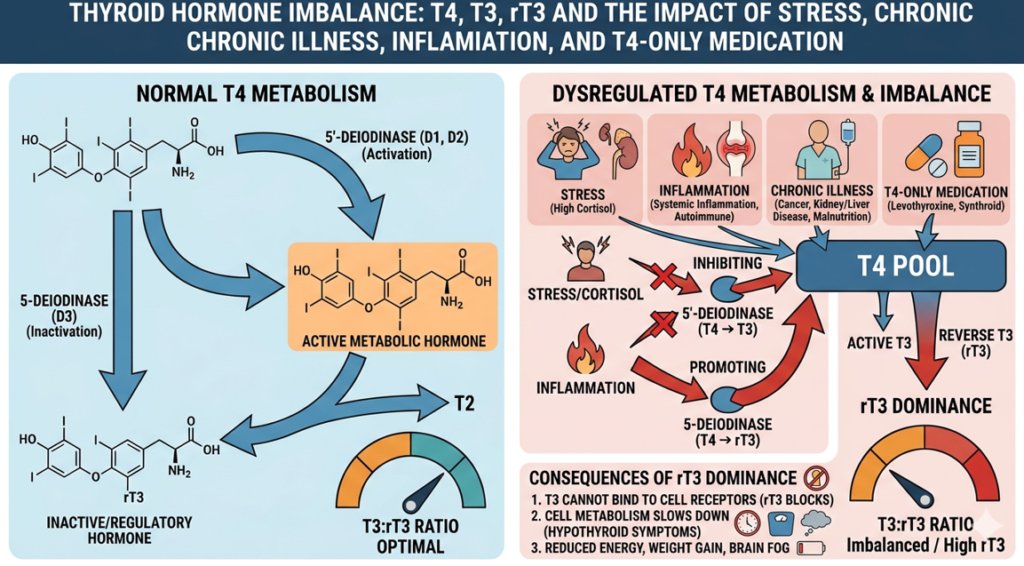
When you are diagnosed with Hashimoto’s, your Doctor likely just focuses on your TSH (Thyroid Stimulating Hormone) and your T4 (the storage hormone). However, your body’s ability to use that hormone depends on a delicate conversion process. Under normal conditions, your body converts T4 into Free T3, which is the active "gasoline" that fuels your cells, heart, and brain.
But your body has an alternative pathway: it can convert T4 into Reverse T3. You can think of it as a "metabolic brake." While it looks nearly identical to active T3, it is biologically inactive. Its primary job is to slow you down to conserve energy. In a healthy system, this is a useful survival mechanism during periods of starvation or acute injury, but in your experience with Hashimoto’s, this brake can become stuck in the "on" position.
The relationship between Hashimoto’s and Reverse T3 is primarily driven by inflammation. Because Hashimoto’s is an autoimmune condition, your immune system is in a state of chronic activation, releasing inflammatory markers called cytokines. These cytokines interfere with the enzymes (deiodinases) responsible for thyroid conversion. Specifically, inflammation inhibits the enzyme that creates active T3 and stimulates the enzyme that creates Reverse T3.
This means that even if your thyroid is producing enough T4 (which means your TSH levels and T4 levels on bloodwork will look normal), or if you are taking a T4 medication like Levothyroxine, your body may be redirecting that hormone into the "brake" pathway. You might find yourself in a frustrating loop where your lab tests look "perfect" to a standard doctor, yet you feel profoundly hypothyroid because your receptors are being blocked.
By measuring your Reverse T3 alongside your Free T3, you can determine your Free T3/rT3 ratio, which provides a much clearer picture of whether your "metabolic engine" is actually getting the fuel it needs to run.
And if I were a betting a man, I’d bet the house that your Doctor has never even run that Reverse T3 marker to test your thyroid function.
See, to reclaim your thyroid gland and your overall health, understanding all of these mechanisms and getting tested to see which of them are involved with your Hashimoto’s hypothyroidism, are critical.
- This requires comprehensive testing which your insurance doesn’t want to pay for.
- This requires an understanding of the testing and how to address these imbalances from a natural, diet & lifestyle perspective
- And finally, and this is important, this requires working with a Doctor who is not interested in masking the problem with a drug (levothyroxine, synthroid, armour thyroid, NP thyroid) because that’s what the insurance company says or what they’ll pay for.
Then for years, you might be on this medication that is “masking” the problem but not addressing the real cause(s).
And that’s where I come in.
I offer a free, 15-30 minute phone call consultation (a Discovery Call) to determine if you're a good fit for my office and to have any of your questions answered. From there we can discuss what tests you need (that your Doctor has ignored) and get some answers. Click here to take advantage of this offer - schedule that free call and start your journey to finally fixing your issue.
Don't suffer with thyroid problems / Hashimoto’s any longer. Let's find out what’s causing your hypothyroidism, and stop masking the problem - let's finally solve it!
TSH and free T4
TSH reflects the pituitary signal to the thyroid; free T4 helps assess circulating hormone. A clinician interprets the pair with symptoms, medication, pregnancy status and relevant history. Results after acute illness or a recent medication change may need different interpretation.
T3, antibodies and reverse T3
T3 is often more helpful in evaluating hyperthyroidism than diagnosing hypothyroidism. TPO or thyroglobulin antibodies may support evaluation of autoimmune thyroid disease; TSH-receptor antibodies address different questions. Reverse T3 is not routinely useful for diagnosing hypothyroidism or guiding replacement treatment in otherwise healthy outpatients. Availability does not establish clinical necessity.
Preparation and follow-up
Provide a complete medicine and supplement list, including biotin. Ask the ordering clinician whether fasting, dose timing or a temporary supplement pause is necessary for your specific test. Do not independently stop medication. Discuss what each proposed test would change, costs and who will explain the results.
What does normal actually mean?
A laboratory result includes a value, units, reference interval and collection date. A result inside that interval does not explain every symptom, and it should not automatically be reclassified as disease using an unvalidated optimal range. TSH with appropriate free T4 testing usually provides more useful information than routine reverse T3 testing.
What else can be considered?
Sleep disorders, anemia, medication effects, depression, anxiety, menopause, nutritional problems and other medical conditions can overlap with thyroid symptoms. Your primary medical clinician can help decide which possibilities warrant investigation. The aim is an accurate diagnosis, not a predetermined thyroid explanation.
How can you prepare?
Record when symptoms began, sleep patterns, major changes, medicines and supplements. Bring complete prior lab reports. A free discovery call can explain the practice’s assessment approach and whether a fuller consultation seems appropriate, but it cannot diagnose you or replace urgent care.
How do you avoid confusing association with cause?
Two health findings can occur together without one proving the cause of the other. For example, an antibody result, a history of an infection and persistent fatigue may all be genuine findings, but the combination does not establish that the infection caused autoimmune thyroid disease or that treating an unrelated laboratory marker will improve thyroid function. Ask what evidence supports the explanation, whether there are alternative explanations and which part of the proposed plan has demonstrated benefit. It is reasonable for an assessment to contain uncertainty. A careful explanation distinguishes established thyroid disease from hypotheses about contributing factors and from general steps that support health. That distinction also prevents a supplement, diet or commercial test from being presented as a proven replacement for standard medical care.
What would an organized review look like?
An organized review starts by confirming the clinical question: an established thyroid diagnosis that needs monitoring, symptoms without a clear diagnosis, or a new structural finding such as a neck lump. Next, assemble existing results and identify gaps that matter for that question. Then discuss a limited set of next steps with a clinician qualified to order and interpret them. Agree on who will communicate the results, the expected follow-up interval and what symptoms require earlier contact. Record how symptoms are affecting daily life so follow-up has a meaningful reference point. This is a consultation-preparation framework, not a branded treatment protocol or a claim that one pathway fits every patient. It can help Wilmington, Leland, Hampstead and Jacksonville residents organize a conversation before deciding whether travel or another consultation is worthwhile.
What questions does a TSH-only result leave open?
A TSH measurement primarily addresses thyroid function in its clinical context. It does not identify every cause of fatigue, show the structure of a neck lump or measure a person’s overall health. The next question should come from the history and examination, not from the assumption that a larger thyroid panel is always superior. Depending on the circumstances, a clinician may consider free T4, another medical explanation or a structural assessment. Bring the exact reason you were tested and the symptoms that remain unresolved. This makes it easier to distinguish an appropriate additional thyroid test from a different investigation altogether.
How do you discuss apparently conflicting laboratory opinions?
Ask both clinicians to describe the same report: the value, units, interval, collection date and relevant medication history. Then ask which accepted clinical finding supports their interpretation. A disagreement may involve missing context, a different question or a proposed threshold that has not been validated for diagnosing disease. Request an explanation in plain language and avoid changing treatment simply to satisfy a preferred number. If a result pattern is unusual or the explanation remains unclear, your medical clinician can discuss whether specialist review is appropriate. A discovery call cannot adjudicate a complex diagnostic disagreement.
What would meaningful follow-up look like when no diagnosis is established?
Agree on the next step and the responsibility for it. This might involve a review of another possible cause, obtaining missing records or observing a symptom with a defined reassessment point. Write down what would warrant earlier medical contact and what information you should collect in the meantime. A symptom diary should describe daily function rather than prove a thyroid theory. Repeating the same test without a new clinical question may not move the assessment forward. Ask what uncertainty the next appointment is expected to resolve and how you will receive the results.
TSH-only testing and targeted additional evaluation
| Assessment | Useful question | Limitation |
|---|---|---|
| TSH | Is the pituitary-thyroid signal appropriate? | Requires clinical interpretation; not a whole-health assessment |
| Free T4 when indicated | How does the function result fit the clinical situation? | Does not identify every cause of symptoms |
| Selected thyroid antibodies | Is an autoimmune explanation relevant? | Not a symptom severity score |
| Ultrasound for a structural concern | Does a lump need further assessment? | Answers a different question from hormone blood tests |
Questions and answers
What questions does a TSH-only result leave open?
A TSH measurement primarily addresses thyroid function in its clinical context. It does not identify every cause of fatigue, show the structure of a neck lump or measure a person’s overall health. The next question should come from the history and examination, not from the assumption that a larger thyroid panel is always superior. Depending on the circumstances, a clinician may consider free T4, another medical explanation or a structural assessment. Bring the exact reason you were tested and the symptoms that remain unresolved. This makes it easier to distinguish an appropriate additional thyroid test from a different investigation altogether.
How do you discuss apparently conflicting laboratory opinions?
Ask both clinicians to describe the same report: the value, units, interval, collection date and relevant medication history. Then ask which accepted clinical finding supports their interpretation. A disagreement may involve missing context, a different question or a proposed threshold that has not been validated for diagnosing disease. Request an explanation in plain language and avoid changing treatment simply to satisfy a preferred number. If a result pattern is unusual or the explanation remains unclear, your medical clinician can discuss whether specialist review is appropriate. A discovery call cannot adjudicate a complex diagnostic disagreement.
Sources and further reading
- American Thyroid Association: Thyroid hormone treatment
- American Thyroid Association: Hashimoto’s thyroiditis
- NIDDK: Thyroid tests
- American Thyroid Association: Thyroid function tests
- NIDDK: Hashimoto’s disease
- NIDDK: Graves’ disease
- American Thyroid Association: Thyroid nodules
- Endocrine Society: Adrenal fatigue
- AAAAI: Limits of food IgG panel testing
- NIDDK: Diagnosis of celiac disease
- American Thyroid Association: Hypothyroidism during pregnancy
Educational information only, not medical advice, diagnosis or a treatment plan. Do not stop, start or change prescribed medication based on this resource. Pregnancy, children, significant heart symptoms and complex endocrine disease require appropriate medical care. Seek emergency help for chest pain, severe breathing difficulty, fainting, or high fever with confusion and a very fast heartbeat. A discovery call is not urgent medical care.