Updated 2026-10-11 · Originally published 2026-03-29
A history of infection or an antibody finding does not by itself prove that an infection caused current thyroid disease or remains active. Explain the illness history and current symptoms to an appropriate clinician, and ask what a proposed test can establish. Avoid treating an association as a confirmed root cause or assuming that an infection panel provides a cure for autoimmune thyroid disease.
Evidence note: The original educational article below is preserved. Added guidance distinguishes established diagnostic methods from hypotheses and test limitations; original claims are not proof that a diet, infection panel or supplement causes or reverses thyroid disease.
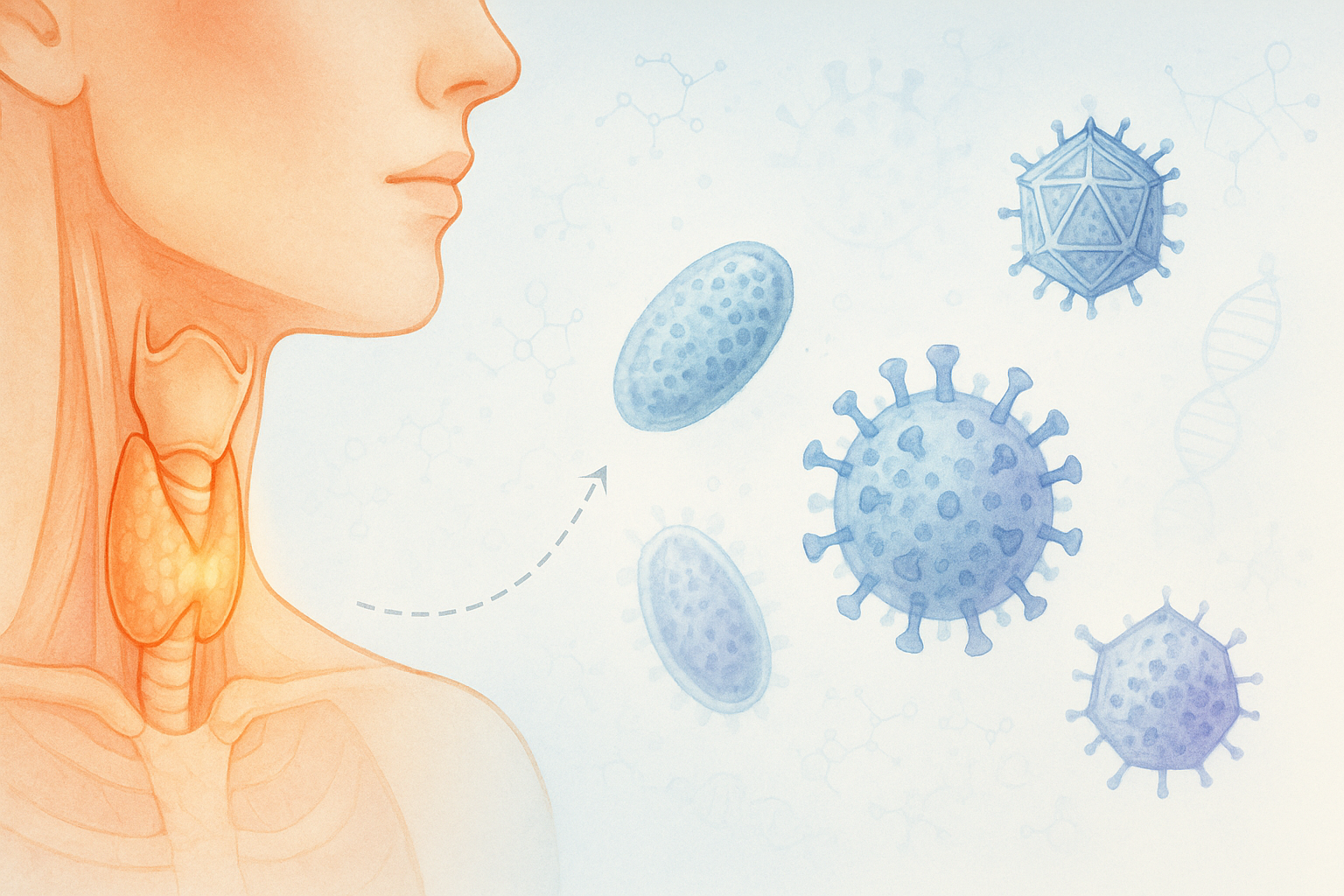
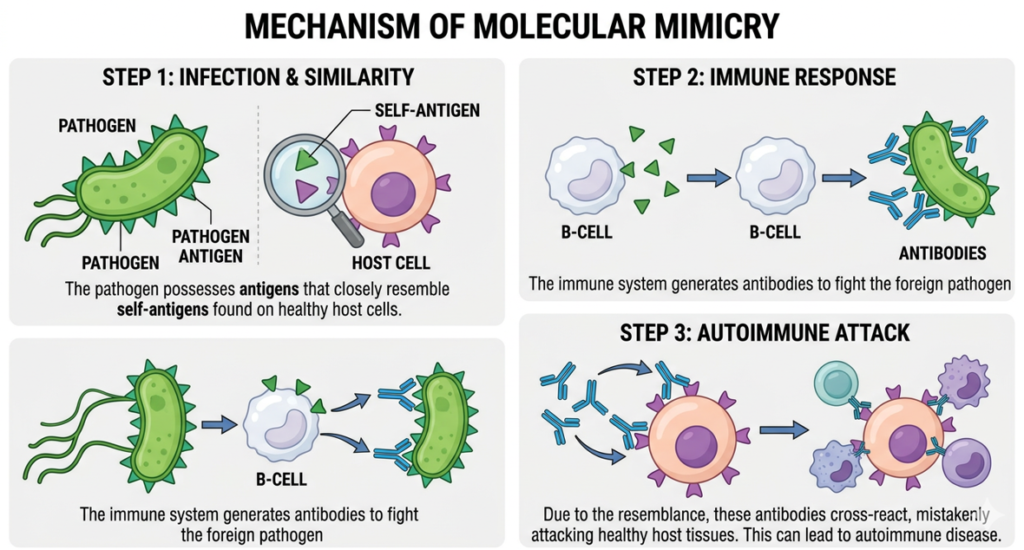
When you consider the health of your thyroid, you likely think of metabolism, energy levels, and temperature regulation. However, your thyroid is also a sensitive target for your immune system, particularly following a viral illness. To understand how a common virus can lead to a lifelong autoimmune condition like Hashimoto’s thyroiditis, you must first understand the concept of molecular mimicry (described earlier in the section labeled “Is My Diet Causing My Hypothyroidism?”).
Molecular Mimicry is a biological "case of mistaken identity." When a virus enters your body, your immune system identifies specific protein sequences on the virus—called antigens—and creates antibodies to destroy them.
Problems arise when these viral proteins happen to look nearly identical to the proteins in your thyroid gland, such as thyroid peroxidase (TPO) or thyroglobulin. In its zeal to protect you, your immune system may lose its ability to distinguish between the harmful invader and your own healthy tissue, leading to a persistent, self-destructive attack on your thyroid.
Beyond mere mimicry, you may also experience "bystander activation." This occurs when a virus infects the thyroid gland directly or the area surrounding it. As your immune system rushes to the site to fight the infection, it releases inflammatory chemicals that damage your thyroid cells. Once these cells are damaged, they spill their internal contents into your bloodstream—contents that are usually hidden from the immune system. Your body then views these leaked thyroid proteins as foreign threats, creating a secondary wave of autoimmune destruction.
This dual-threat mechanism—mistaken identity combined with localized collateral damage—explains why you might find yourself diagnosed with hypothyroidism months or even years after a seemingly unrelated viral infection.
THE ROLE OF EPSTIN-BARR VIRUS
If you have ever suffered from "mono" (infectious mononucleosis), you have hosted the Epstein-Barr Virus. Even after you recover from the initial fatigue and sore throat, EBV never truly leaves your body; it remains latent in your B-lymphocytes. Research suggests that if you have a genetic predisposition to Hashimoto’s, the presence of EBV can act as a primary trigger. When the virus reactivates or even while it is dormant, your immune system’s attempt to keep it in check can lead to the production of antibodies that cross-react with your thyroid. Specifically, the EBV nuclear antigen-1 has sequences that mimic thyroid proteins. You may find that your TPO antibody levels spike during or after periods of high stress when the virus is more likely to be active, suggesting that your immune system is caught in a perpetual loop of attacking your thyroid while trying to suppress the virus.
HEPATITIS C VIRUS (HCV) AND THE TREATMENT PARADOX
The connection between Hepatitis C and your thyroid is particularly strong and scientifically well-documented. If you are living with chronic HCV, you are at a significantly higher risk for developing thyroid antibodies compared to the general population. The virus appears to have a unique "tropism," or attraction, to thyroid tissue, potentially infecting the cells directly and altering their function. However, you might also face a secondary challenge: the treatments used to manage HCV, such as interferon-alpha, are known to stimulate the immune system so aggressively that they can "unmask" a latent tendency toward Hashimoto’s. For many, the virus serves as the initial spark that disrupts immune tolerance, making it difficult for your body to regain its balance even after the viral load is reduced.
THE PERSISTENT THREAT OF HHV-6 AND HSV 1 & 2
Herpesviruses, including Human Herpesvirus 6 (HHV-6) and Herpes Simplex Virus (HSV 1 & 2), are masters of evasion and persistence. If you carry HHV-6, the virus can actually integrate its DNA into your own, often hiding within the thyroid follicular cells themselves. Studies have shown that in a high percentage of patients with Hashimoto’s, HHV-6 is found actively replicating within the thyroid gland, whereas it is absent in healthy thyroids. This means your immune system isn't just attacking a ghost of a past infection; it is actively trying to purge a virus that has taken up residence inside your hormone-producing cells. Similarly, the inflammatory environment created by recurring HSV outbreaks can keep your immune system in a state of "high alert," making it more likely that your defenses will mistakenly target thyroid proteins through the molecular mimicry of viral envelopes.
THE MODERN TRIGGER: COVID-19 (SARS-COV-2)
In the wake of the global pandemic, you may have heard of "long COVID," but the virus’s impact on the endocrine system is equally significant. SARS-CoV-2 utilizes the ACE2 receptor to enter cells, and since your thyroid gland is rich in these receptors, it is a prime target for direct infection. When you contract COVID-19, your body may undergo a "cytokine storm," an extreme overreaction of the immune system that causes widespread inflammation. This intense environment can shatter your immune tolerance. Furthermore, the spike protein of the virus shares several amino acid sequences with thyroid tissue. If your body develops a robust antibody response to the spike protein, you may inadvertently develop a robust attack against your thyroid, leading to the rapid onset of Hashimoto’s or a significant worsening of pre-existing thyroid inflammation.
Now, I imagine you’ve gotten Covid and been tested for Covid before. But ask yourself this:
- Has your immune system “calmed down” afterwards? Has your Doctor tested you for that?
- Has your Doctor tested you for the different Herpes viruses?
- Has your Doctor tested you for Epstein-Barr virus (EBV)?
- Has your Doctor tested you for Hepatitis C?
And my guess is, your Doctor has not done this.
See, to reclaim your thyroid gland and your overall health, understanding all of these mechanisms and getting tested to see which of them are involved with your Hashimoto’s hypothyroidism, are critical.
- This requires comprehensive testing which your insurance doesn’t want to pay for.
- This requires an understanding of the testing and how to address these imbalances from a natural, diet & lifestyle perspective
- And finally, and this is important, this requires working with a Doctor who is not interested in masking the problem with a drug (levothyroxine, synthroid, armour thyroid, NP thyroid) because that’s what the insurance company says or what they’ll pay for.
Then for years, you might be on this medication that is “masking” the problem but not addressing the real cause(s).
And that’s where I come in.
I offer a free, 15-30 minute phone call consultation (a Discovery Call) to determine if you're a good fit for my office and to have any of your questions answered. From there we can discuss what tests you need (that your Doctor has ignored) and get some answers. Click here to take advantage of this offer - schedule that free call and start your journey to finally fixing your issue.
Don't suffer with thyroid problems / Hashimoto’s any longer. Let's find out what’s causing your hypothyroidism, and stop masking the problem - let's finally solve it!
Start with symptoms and history
Discuss bowel changes, abdominal discomfort, diet, medicines, travel, infections and warning signs. Persistent bleeding, severe pain, dehydration or unexplained weight loss requires medical evaluation. Stool tests for a suspected infection are not interchangeable with commercial microbiome reports.
Celiac testing and gluten
Autoimmune thyroid disease and celiac disease can occur together, but not everyone with thyroid disease has celiac disease. If celiac testing is being considered, talk with your medical clinician before removing gluten because avoidance can affect results. Celiac evaluation is distinct from a food IgG sensitivity panel.
Use results carefully
Ask about validation, false positives, the need for confirmation and how results would change care. A gut report should not be used as proof that intestinal permeability caused Hashimoto’s or that a restrictive diet will reverse it. Gastroenterology referral may be appropriate.
What does Hashimoto’s mean?
The immune system targets thyroid tissue. Some people have antibodies while their hormone levels remain in range; others develop hypothyroidism. The words Hashimoto’s and hypothyroidism are therefore related but not interchangeable. Understanding which finding is present helps patients have a clearer discussion about monitoring, medication and other possible explanations for symptoms.
Which tests answer which questions?
TSH and free T4 help assess thyroid function. Thyroid peroxidase antibodies, and sometimes thyroglobulin antibodies, can support assessment of an autoimmune cause. An antibody number is not a symptom score or a target that everyone should try to lower with supplements. Ultrasound is considered when examination or other findings suggest a structural issue, not automatically for every person with antibodies.
What can supportive care include?
Reviewing sleep, nutrition, medications, digestive symptoms and documented deficiencies can make care more comprehensive. Supportive care does not replace thyroid hormone when it is medically necessary. Wilmington Functional Medicine can discuss whether its assessment approach fits your concerns; prescribing decisions and specialist treatment remain with the appropriate licensed medical professional.
Questions and answers
What should I know about start with symptoms and history?
Discuss bowel changes, abdominal discomfort, diet, medicines, travel, infections and warning signs. Persistent bleeding, severe pain, dehydration or unexplained weight loss requires medical evaluation. Stool tests for a suspected infection are not interchangeable with commercial microbiome reports.
What should I know about celiac testing and gluten?
Autoimmune thyroid disease and celiac disease can occur together, but not everyone with thyroid disease has celiac disease. If celiac testing is being considered, talk with your medical clinician before removing gluten because avoidance can affect results. Celiac evaluation is distinct from a food IgG sensitivity panel.
Sources and further reading
- American Thyroid Association: Thyroid hormone treatment
- American Thyroid Association: Hashimoto’s thyroiditis
- NIDDK: Thyroid tests
- American Thyroid Association: Thyroid function tests
- NIDDK: Hashimoto’s disease
- NIDDK: Graves’ disease
- American Thyroid Association: Thyroid nodules
- Endocrine Society: Adrenal fatigue
- AAAAI: Limits of food IgG panel testing
- NIDDK: Diagnosis of celiac disease
- American Thyroid Association: Hypothyroidism during pregnancy
Educational information only, not medical advice, diagnosis or a treatment plan. Do not stop, start or change prescribed medication based on this resource. Pregnancy, children, significant heart symptoms and complex endocrine disease require appropriate medical care. Seek emergency help for chest pain, severe breathing difficulty, fainting, or high fever with confusion and a very fast heartbeat. A discovery call is not urgent medical care.