Updated 2026-10-11 · Originally published 2026-03-29
A stressful period and thyroid symptoms can occur together without stress being established as the cause of hypothyroidism. Diagnosis depends on appropriate thyroid assessment, while sleep disruption and stress deserve their own attention. An assessment should distinguish documented hormone deficiency from other explanations for fatigue and avoid using an adrenal-fatigue label as a substitute for a medical diagnosis.
Evidence note: The original educational article below is preserved. Added guidance distinguishes established diagnostic methods from hypotheses and test limitations; original claims are not proof that a diet, infection panel or supplement causes or reverses thyroid disease.
First, let’s make sure we understand what the adrenal glands are AND what the thyroid gland is.
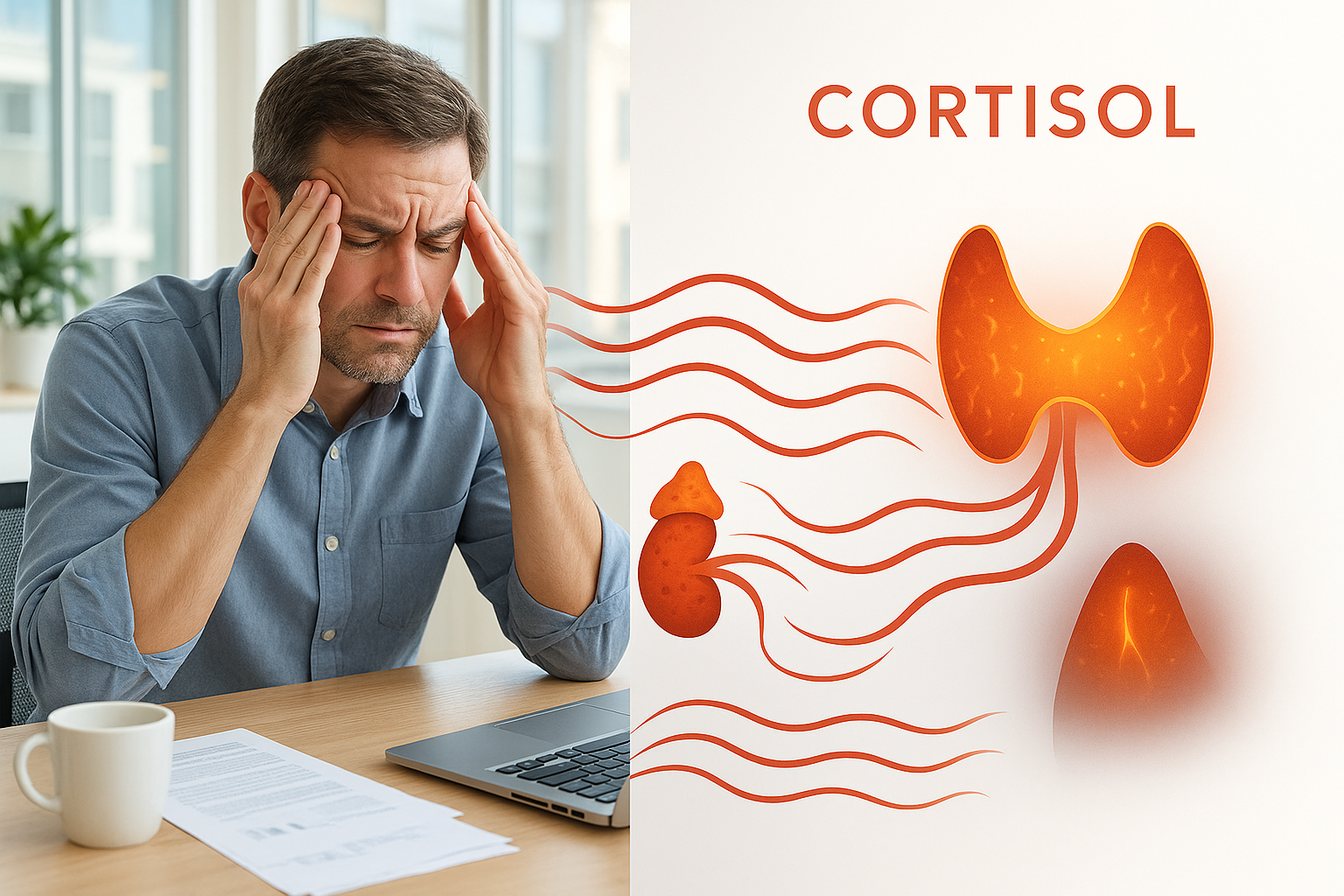
The adrenal glands are small, triangular-shaped organs located on top of each kidney (mid-lower back). The adrenal glands act as "bodyguards" that regulate nearly every organ in your body through managing the “Fight or Flight” response. They release cortisol to provide an energy boost during emergencies (like increasing heart rate, faster breathing, quick breakdown of stored nutrients for fuel) as well as manage long-term stress.
Your thyroid is the master regulator of your metabolism. It is a small, butterfly-shaped organ at the base of your neck and it takes iodine from your diet and converts it into thyroid hormones: T4, T3 and calcitonin (as mentioned earlier).
What’s amazing is how intertwined these 2 glands are. Take a look:
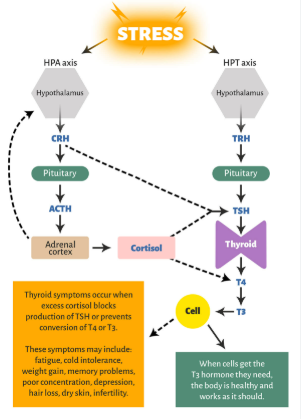
I’m going to spend some time explaining this diagram because it is critical for you to understand this so you can grasp how your adrenal function (high, low) could be causing your Hashimoto’s.
On the left hand side, you will see what is called the HPA axis.
- H = Hypothalamus
- P = Pituitary
- A = Adrenal glands
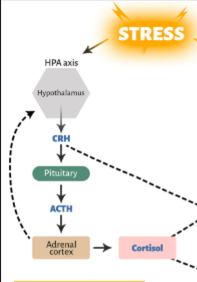
This side of the diagram shows what happens to your Adrenal Glands when you experience stress:
- The brain, starting with the Hypothalamus, sends CRH hormone to the Pituitary gland.
- The Pituitary turns around and sends ACTH hormone to the Adrenal glands to kick in gear.
- The Adrenals release cortisol → THE STRESS HORMONE!
Now on the right side of the diagram, you will see what is called the HPT axis. Interestingly, the “H” and the “P” in both of these hormonal axes, are the same (Hypothalamus and Pituitary):
- H = Hypothalamus
- P = Pituitary
- T = Thyroid gland
This side of the diagram shows what happens with the thyroid gland when you experience stress:
- The brain, starting with the Hypothalamus, sends TRH hormone to the Pituitary gland.
- The Pituitary turns around and sends TSH hormone to the Thyroid gland to kick in gear.
- The Thyroid gland releases T4 → the major thyroid hormone (which will later convert to T3 as the body needs).
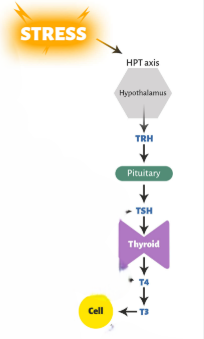
Clearly both the Adrenal glands AND the Thyroid gland are involved in the STRESS RESPONSE.
But here’s what’s fascinating:
When we are in fight/flight mode for a long period of time (chronic stress), high, consistent levels of cortisol inundate the body and reduces the brain’s communication to the thyroid (by blocking TSH)
AND
High, consistent levels of cortisol blocks the conversion of T4 (inactive thyroid hormone) into T3 (the active thyroid hormone).
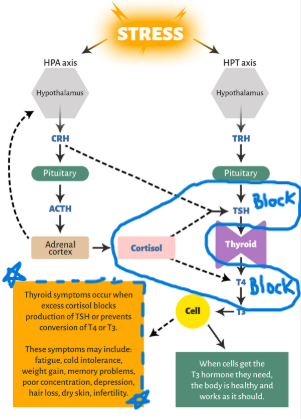
As you can see above this in the orange box, It’s a double whammy effect => Hypothyroidism. This is how stress causes your thyroid to stop working and leads to:
- Fatigue
- Can’t tolerate cold well
- Weight gain
- Memory problems
- Poor concentration
- Depression
- Hair loss
- Dry skin
- Infertility
- Brain fog
To reclaim your thyroid gland and your overall health - you’ve got to figure out what’s actually going on with your adrenals and thyroid….
- This requires comprehensive testing that your insurance company doesn’t want to pay for
- This requires an understanding of the testing and how to address these imbalances from a natural, diet & lifestyle perspective
- And finally, and this is important, this requires working with a Doctor who is not interested in masking the problem with a drug (levothyroxine, synthroid, armour thyroid, NP thyroid) because that’s what the insurance company says or what they’ll pay for.
Since you’re reading this, my guess is that you or someone you love, is on a thyroid medication and has been for quite some time. Why? Because your Doctor (your primary or your endocrinologist) tells you that you need to get on this medication and mentions nothing (and I mean ZERO) about what’s actually causing the problem. Then for years, you might be on this medication that is “masking” the problem but not addressing the real cause.
And that’s where I come in.
I offer a free, 15-30 minute phone call consultation (a Discovery Call) to determine if you're a good fit for my office and to have any of your questions answered. From there we can discuss what tests you need (that your Doctor has ignored) and get some answers. Click here to take advantage of this offer - schedule that free call and start your journey to finally fixing your issue.
Don't suffer with thyroid problems / Hashimoto’s any longer. Let's find out what’s causing your hypothyroidism, and stop masking the problem - let's finally solve it!
Stress symptoms versus adrenal disease
Poor sleep and prolonged stress deserve attention, but adrenal insufficiency and other endocrine diseases require validated diagnostic pathways. Suspected adrenal insufficiency needs appropriate medical assessment; severe weakness, vomiting, fainting or dehydration should not wait for a wellness consultation.
Why collection context matters
Time of day, medicines, menstrual timing, pregnancy, contraception and menopause can affect hormone results. A single value detached from this context can be misleading. The clinician should explain why blood, urine or saliva sampling is appropriate for the question being asked and what the test cannot conclude.
Questions before ordering
Ask whether the result would change your care, whether confirmatory testing is needed and whether an endocrinologist or gynecologist should be involved. Testing offered by the practice is selected through consultation, not a promise that every person needs every hormone measured.
How is an underactive thyroid evaluated?
TSH is commonly the initial test, interpreted with free T4 when indicated. A raised TSH with low free T4 differs from a raised TSH with free T4 still in range. Pregnancy, pituitary disease, recent illness and medication use can change interpretation. Bring the actual reports, units and reference ranges rather than a recollection that a result was normal.
Does everyone need the same medication?
Levothyroxine is the usual hormone replacement for established hypothyroidism. The prescribing clinician determines whether treatment is indicated, the dose and follow-up. Persistent symptoms warrant a careful review, not unsupervised dose escalation. This practice resource is not an offer of prescribing or a substitute for medication monitoring.
What if symptoms persist?
A review can consider medication administration, supplements, sleep quality, anemia, mood, menopausal symptoms and other explanations. More tests are not automatically better. A useful test answers a specific question and has a realistic next step if the result is abnormal.
Does the timing of stress establish a thyroid cause?
Symptoms beginning during a demanding period can suggest questions worth asking, but timing alone cannot establish causation. For example, reduced sleep and a newly discovered abnormal thyroid test could occur together while requiring different responses. Explain the sequence without assuming one explanation accounts for everything. Ask your clinician which findings establish hypothyroidism and which symptoms might reflect other factors. This helps prevent a stress explanation from delaying necessary hormone treatment, and it also prevents a thyroid label from obscuring treatable sleep or mental-health concerns.
Questions and answers
Does the timing of stress establish a thyroid cause?
Symptoms beginning during a demanding period can suggest questions worth asking, but timing alone cannot establish causation. For example, reduced sleep and a newly discovered abnormal thyroid test could occur together while requiring different responses. Explain the sequence without assuming one explanation accounts for everything. Ask your clinician which findings establish hypothyroidism and which symptoms might reflect other factors. This helps prevent a stress explanation from delaying necessary hormone treatment, and it also prevents a thyroid label from obscuring treatable sleep or mental-health concerns.
Sources and further reading
- American Thyroid Association: Thyroid hormone treatment
- American Thyroid Association: Hashimoto’s thyroiditis
- NIDDK: Thyroid tests
- American Thyroid Association: Thyroid function tests
- NIDDK: Hashimoto’s disease
- NIDDK: Graves’ disease
- American Thyroid Association: Thyroid nodules
- Endocrine Society: Adrenal fatigue
- AAAAI: Limits of food IgG panel testing
- NIDDK: Diagnosis of celiac disease
- American Thyroid Association: Hypothyroidism during pregnancy
Educational information only, not medical advice, diagnosis or a treatment plan. Do not stop, start or change prescribed medication based on this resource. Pregnancy, children, significant heart symptoms and complex endocrine disease require appropriate medical care. Seek emergency help for chest pain, severe breathing difficulty, fainting, or high fever with confusion and a very fast heartbeat. A discovery call is not urgent medical care.